
Services
Bird Control Services in Singapore
Survey-led bird and pigeon control for Singapore's pest birds: pigeons, Javan and common mynas, and house crows. We find and cut the food sources, proof ledges and roofs at height, clean up safely and count the birds, so you can see what changed.
Call +65 9149 1408Pest birds are one of the most stubborn building problems in Singapore. Here that means feral pigeons, mynas (both the Javan myna and the common myna) and house crows. They roost on ledges, nest in service areas and roof spaces, foul facades and walkways with droppings, and can carry mites and germs, which matters most around food areas. ESC's bird control is built on survey, food control and proofing, not one-off chasing.
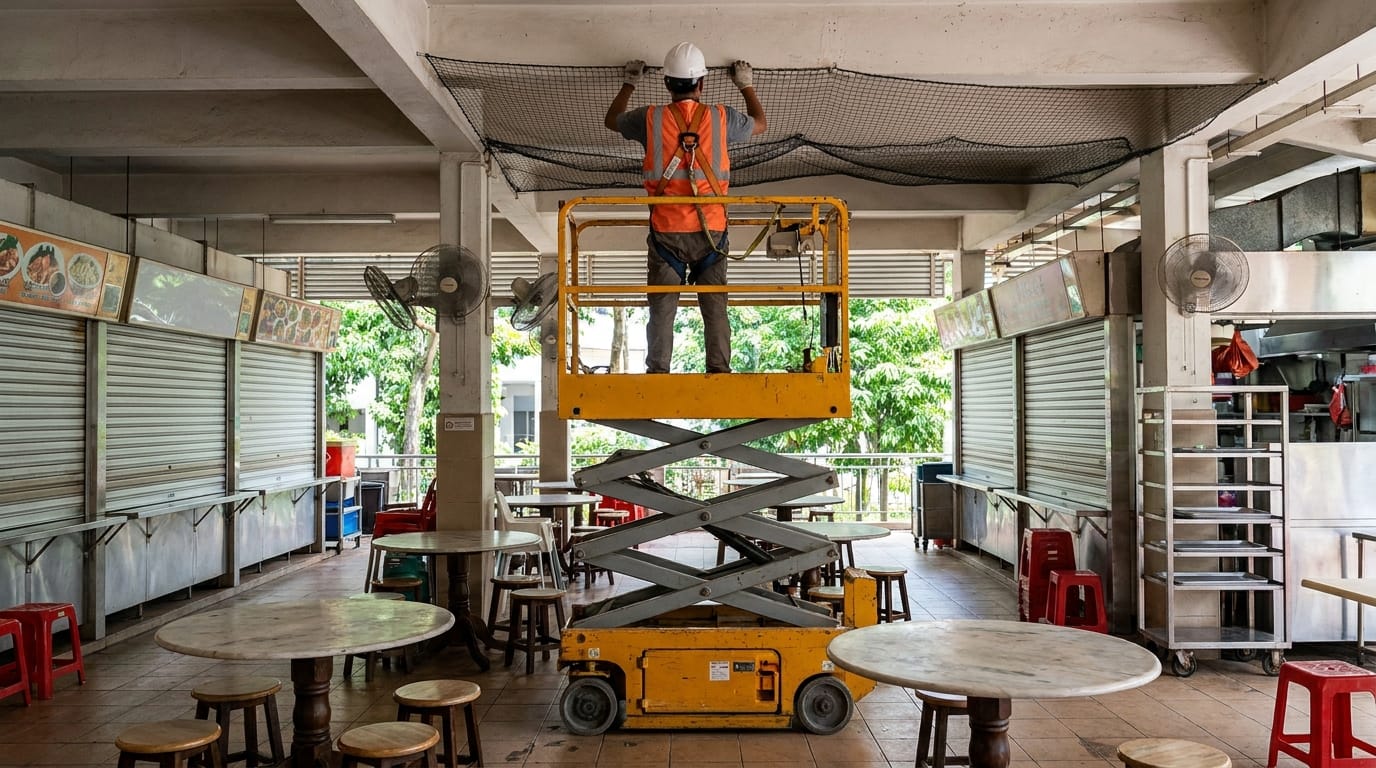
Where bird problems usually start: air-con ledges and rooftops at condos, common corridors and void deck beams in HDB estates, bin centres and refuse points, mall and office facades, coffeeshop and hawker centre ceilings, and warehouse roof trusses and loading bays. Most of these spots are high up, which is why every ESC officer is trained and certified for work at height.
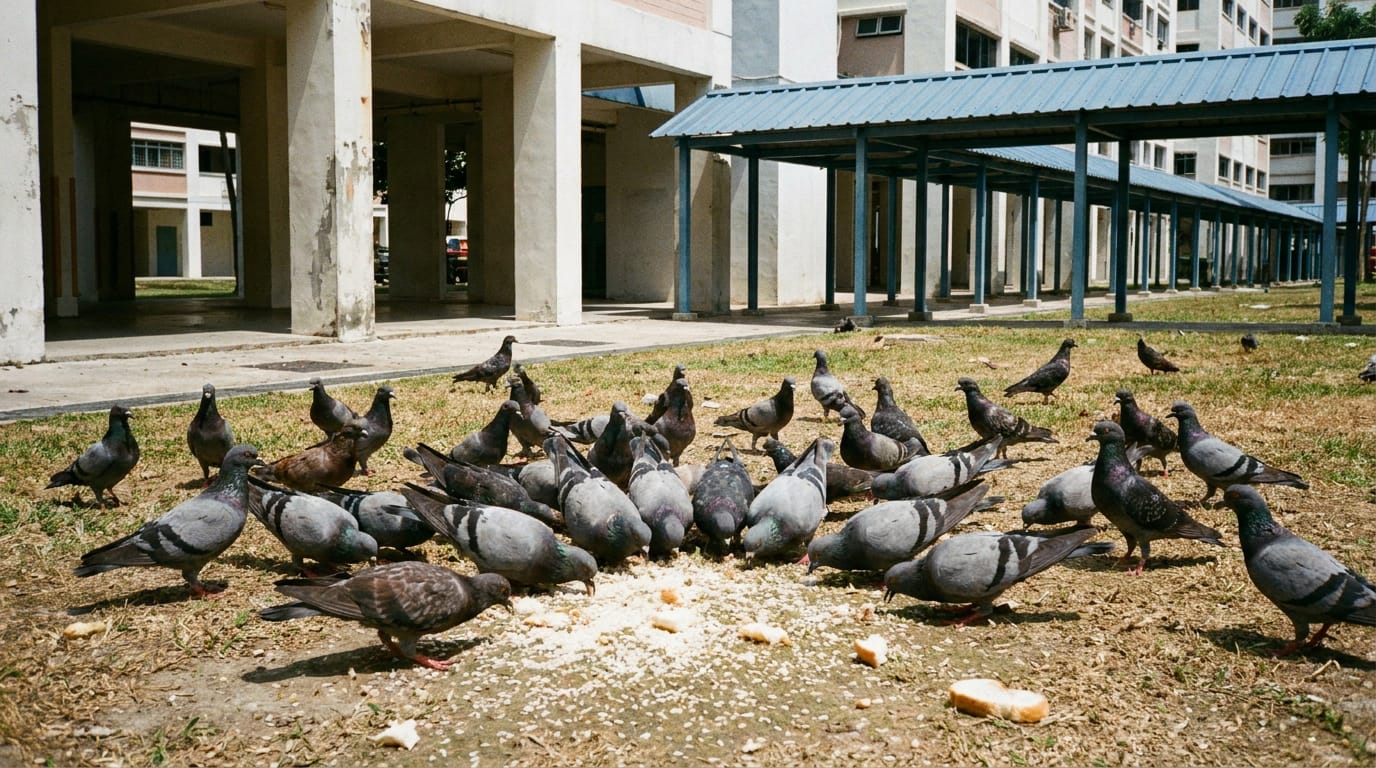
Pigeon control works in a set order: food first, then nesting spots, then numbers. Removing birds on its own does not last, because when the food and ledges stay, pigeons from nearby blocks fill the gap within days. Where numbers still need to come down, any trapping is carried out only with the approvals required, coordinated with the town council or MCST, and always alongside food control and proofing.
You get evidence, not just a job sheet. We count the birds at fixed points before we start and at every follow-up visit, map active nests, photograph the same spots each time and log feeding hotspots. The written report shows the trend against your starting numbers, ready for an MCST committee, a town council meeting or an audit.
What We Do
Scope of service
Bird survey & counts
We confirm which birds are involved, count them at fixed points at dusk, map nests, roosts and food sources, and photograph marked spots. Those starting numbers set the scope, the quote and the yardstick for results.
Food-source & bin centre audit
Bin centres, refuse chutes, tray return points, coffeeshops and loading bays checked for the food that keeps flocks breeding all year, with a practical housekeeping plan and resident notices that explain why feeding keeps birds coming back.
Netting, spikes & wire at height
Netting for air wells, plant rooms, ceilings and loading bays. Stainless-steel spikes, tensioned wire and mesh for ledges, beams, pipes, signboards and parapets. Neat, discreet and planned across whole stacks or facades, installed by officers trained and certified for work at height.
Pigeon population management
For estates and large sites: food first, then nesting spots, then numbers. We work with your managing agent or town council, and any trapping to bring numbers down is subject to the approvals required under Singapore's Wildlife Act and always runs alongside food control and proofing.
Nest & roost work
Species check before any nest is touched. Empty nests and roosting debris are removed, and the spot is disinfected and proofed. Nests with eggs or chicks are left until the young have flown, or removed only subject to the approvals each species requires. We never seal birds in behind netting.
Dropping cleaning & disinfection
Bird and pigeon droppings wetted down, removed and disinfected on facades, ledges, plant rooms, car parks and walkways, with a check for bird mites. We clean before we proof, so old mess and smell are not sealed in.
Monitoring & photo reports
Follow-up visits repeat the counts at the same spots, check every net and spike, and fix any gaps. You get a short photo report showing the trend against your starting numbers, ready for a committee meeting or audit.
Who This Is For
Built for the people responsible
- Town councils (HDB common areas and bin centres)
- Condominium MCSTs and managing agents
- Commercial buildings, malls and hotels
- F&B outlets, coffeeshops and food courts
- Industrial, logistics and warehouse facilities
- Construction sites needing bird nest checks before works
Approach & compliance
- Food and proofing first. Removing birds on its own does not last: when food and ledges remain, pigeons from nearby blocks move in within days.
- Species check before any nest is touched. Some native birds also nest on buildings, and their eggs and chicks cannot be removed without written approval under Singapore's Wildlife Act.
- Any trapping, or removal of nests with eggs or chicks, is subject to the approvals each species requires and coordinated with the town council, MCST or building owner. We never seal birds in behind netting.
- No poison baits and no glue traps.
- Every ESC officer is trained and certified for work at height, and high work follows the site's permit-to-work and fall-protection procedures.
- Photo-documented reports, suitable for MCST committees, town council meetings and audit records.
FAQ
Frequently asked questions
How much does bird control cost in Singapore?
It depends on the site and the work needed. Spikes or netting for a few ledges can often be done in a day, while block-wide proofing is planned in stages around residents and access. Population and food-source programmes run longer, with follow-up visits and counts over several months. We quote after a site survey, with a written scope listing each area and method, so you can compare quotes like for like.
Spikes or netting: which do we need?
We specify by spot, not by product. Spaces birds fly into, such as air wells, plant rooms and loading bays, get netting. Ledges, beams, pipes and signboards where birds land get stainless-steel spikes or tensioned wire. Holes and eaves where Javan and common mynas nest get mesh or gap sealing. We plan across the whole stack or facade so birds are not just pushed to the next ledge, and check every installation on follow-up visits.
Do netting and spikes hurt the birds?
They are designed not to: spikes stop birds landing, and netting keeps them out of a space. Before we close any net, we check that no birds, eggs or chicks are behind it, and we inspect installations on follow-up visits to fix any gap before a bird can get caught.
Can you proof our condo's air-con ledges?
Yes. We can work with MCSTs and managing agents on air-con ledges, rooftops and facades across a whole block, so birds are not simply pushed from one ledge to the next. Many condos have by-laws on netting and facade fixings, so we agree the method, colour and access with the managing agent before any work starts.
What happens during a bird control job?
First a survey: which birds, how many at fixed points at dusk, and where they feed, roost and nest. You get a written scope listing each area and method. On site, droppings are wetted, removed and disinfected first, then ledges and spaces are proofed with netting, spikes or wire, at height where needed. Follow-up visits repeat the counts at the same spots and check every installation, and a short photo report shows the trend.
Can you get rid of pigeons for good?
No one can honestly promise that, and we will not. Pigeons go where there is food and a safe ledge. What lasts is cutting the food nearby, proofing every spot they use across the whole stack or facade, and checking regularly, so your site stops being worth coming back to. We count the birds before and after, so you can see the result for yourself.
Will netting or spikes make my building look bad?
Properly specified and installed, bird proofing is discreet. Netting can be colour-matched and tensioned neatly, and spikes are installed out of normal sight lines. We plan installations to protect both the building and its appearance.
Can you help reduce our estate's pigeon numbers?
We can help. We start with a count and a map of food sources, roosts and nests, then cut the food, proof the roosting and nesting spots and support resident outreach. Where your town council or MCST also runs population reduction, we support it with proofing, food-source work and counts, so the cleared area does not fill up again. Any trapping is carried out only with the approvals required, coordinated with the town council or MCST.
Do ultrasonic devices or plastic owls work?
Not on their own. Pigeons, Javan mynas, common mynas and crows get used to sounds, lights and decoys within days or weeks. Food control and physical proofing do the real work, so that is where we put your budget.
Do you remove nests with eggs or chicks?
We identify the species first, because some native birds also nest on buildings, and their eggs and chicks cannot be removed without written approval under Singapore's Wildlife Act. Empty nests are removed and the spot is disinfected. Where there are eggs or chicks, our default is to leave the nest until the young have flown, then clear and proof the spot. Any removal of a nest with eggs or chicks is subject to the approvals each species requires.
Is pigeon dropping dangerous?
Small amounts of fresh droppings are mainly a cleaning and slip problem. The risk comes from large, dried build-ups: disturbing them raises dust that can carry fungi and bacteria linked to lung infections, which matters most for anyone with a weak immune system. So never dry-sweep a big build-up. We wet droppings before removal, wear masks and protective suits, and disinfect the area.
Can you work at height on high-rise facades?
Yes. Every ESC officer is trained and certified for work at height, and high work follows the site's permit-to-work and fall-protection procedures. We plan safe access for each job and agree it with the managing agent or site team before work starts.
Need help with Pest Bird Control?
Urgent wildlife situation? Call or WhatsApp +65 9149 1408. Other enquiries: we reply within one business day.