
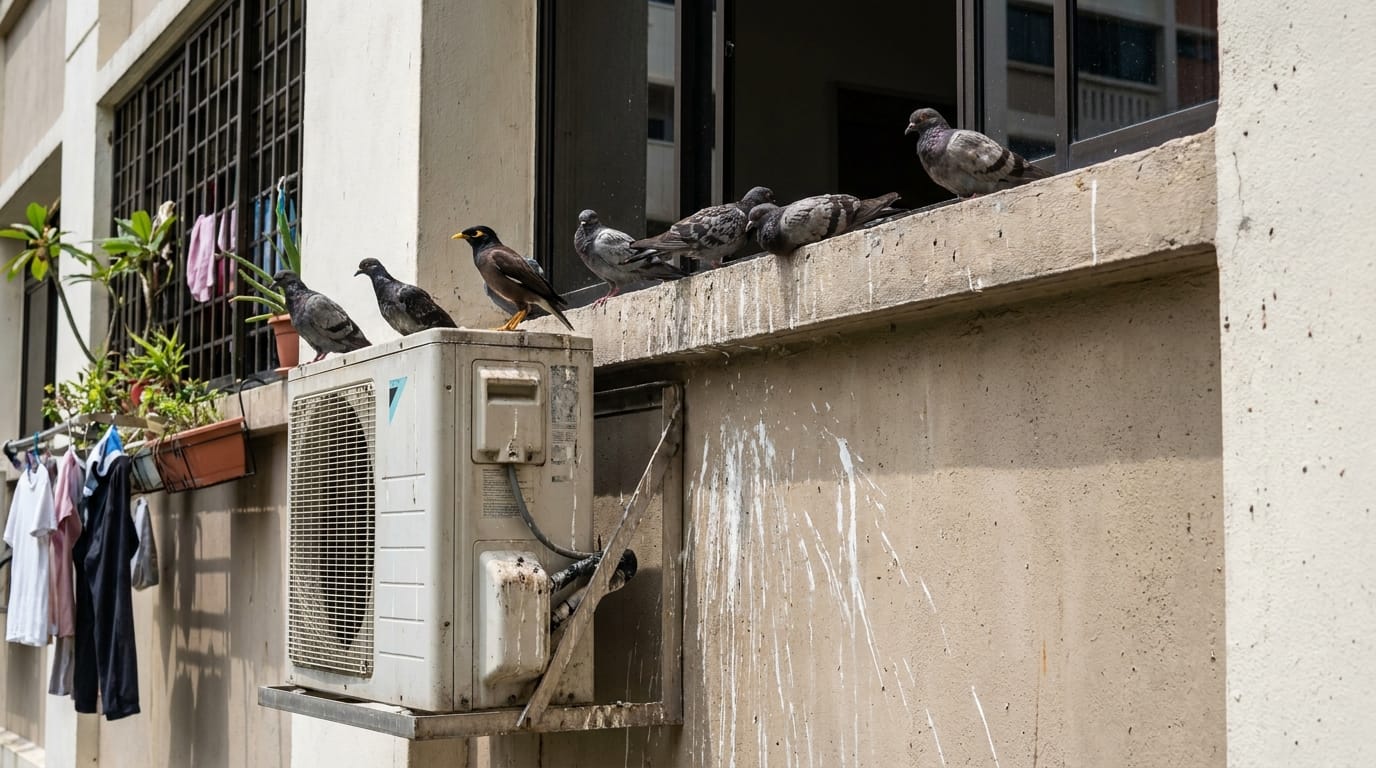
Pigeons, mynas (both the Javan myna and the common myna) and house crows are Singapore's pest birds. They foul ledges, air-con ledges and walkways, nest in service areas and roof spaces, and gather wherever food is easy to find. Because birds are smart and loyal to a good site, the usual quick fixes (shooing them off, netting one ledge, a plastic owl) rarely change much for long.
Short answer: take away the food, clean up the droppings, and block the ledges and gaps the birds use, across the whole block if you can. This guide explains why that order works, how pigeon population control works in Singapore, what you can safely do yourself, and when to call a specialist.
Pigeon, Javan myna, common myna or house crow? Know which bird you have
The right fix depends on the bird. Pigeons are mostly a ledge and food problem, Javan and common mynas a gap and roost-tree problem, and house crows a bin and tall-tree problem.
- Feral pigeons: grey birds with a shiny green and purple neck. They roost and nest on ledges, air-con ledges, beams and roof spaces, and breed all year round when food is easy.
- Javan mynas and common mynas: Javan mynas are black with a yellow beak and white wing patches, and common mynas are brown with a black head and a yellow patch around the eye. Both nest in gaps, eaves, signboards and roof spaces, and gather in noisy tree roosts at dusk.
- House crows: large black birds with a grey neck. They roost in tall trees, scavenge from bins and eating areas, and may swoop at people near their nests.
Why the birds keep coming back
A building with a bird problem is offering the birds something: food (open bins, table scraps, well-meaning feeders), shelter (ledges, beams, plant rooms, signboard gaps) or a safe, high place to roost. Until that offer is taken away, chasing them off works for a few days at most, or another flock takes their place.
Old droppings also tell birds that a spot is safe, which is why cleaning matters as much as proofing.
What about pigeon population control?
Pigeon numbers follow food. Studies of city pigeons in Europe found that cutting food made the biggest difference: in Barcelona, a campaign persuading residents to stop feeding cut pigeon numbers by about 40 percent within a year in the districts where it ran, and in Venice a ban on selling pigeon feed in St Mark's Square was followed by a steep fall in the flock.
Removing birds on its own does not last. Barcelona removed more than 200,000 pigeons over about 15 years and the population still grew, because when birds are taken away but the food stays, pigeons from nearby areas fill the gap within days.
In Singapore, town councils are rolling out a pigeon management approach in phases. It works on several fronts at once: less food waste at bin centres and eating areas, action against illegal feeding, changes to roosting and nesting spots, and humane trapping in hotspots to bring numbers down. A pilot in three town council areas from July 2024 to March 2025 reported an estimated drop of about half in pigeon numbers.
Residents and MCSTs should not trap birds themselves. Depending on the species and the method, trapping can need written approval under the Wildlife Act, it carries animal welfare duties, and traps catch native birds and pets too. Leave it to the town council's programme or a specialist working with the approvals required.
What a building can do follows the same order that works everywhere: food first, then nesting spots, then numbers.
- Food: lidded bins, clean bin centres and refuse chutes, prompt tray and plate clearing, and no feeding.
- Nesting spots: clean first, then proof ledges, air-con ledges, beams and roof spaces across the whole stack or facade, not one unit at a time.
- Residents: clear notices explaining why feeding keeps the birds coming back.
- Counts: a simple count of birds and nests before and after, so the committee can see whether it is working.
What you can do yourself today
A few simple steps make your home or building far less attractive to pest birds:
- Do not feed the birds, and ask neighbours not to. Feeding wildlife, including pigeons, Javan and common mynas and crows, is an offence under Singapore's Wildlife Act.
- Keep food and rubbish covered: close bin lids, clear plates and trays promptly, and do not leave pet food outside.
- Clean droppings while they are fresh. Wet them first, wear gloves and a mask, and disinfect the spot afterwards.
- Clear loose nesting material from ledges, pipes and air-con ledges before birds settle, as long as there are no eggs or chicks.
- Check with your town council or MCST before you drill into or fix netting to the outside of your flat or unit.
What not to do
Some common reactions make things worse, or break the law:
- Do not use poison or glue traps. They are cruel, put pets and native birds at risk, and causing an animal unnecessary suffering is an offence under Singapore's animal welfare law.
- Do not set traps yourself. Leave population work to the town council's programme or a specialist.
- Do not net over an active nest or seal birds in.
- Do not rely on ultrasonic devices, smells, shiny objects or plastic owls on their own. Birds get used to them within days or weeks.
- Do not dry-sweep or blow away dried droppings. The dust is what carries the health risk.
- Do not lean out of windows or climb onto ledges to reach a nest or put up netting. High work needs proper fall protection.
Netting or spikes: which to choose
Both are physical barriers, and most buildings need a mix. As a rule of thumb:
- Netting closes off a space birds fly into: balconies, air wells, air-con ledge areas, plant rooms, ceiling voids and loading bays. Tensioned neatly and colour-matched, it is hard to notice from the street.
- Spikes stop birds landing along a line: ledges, parapets, beams, pipes and signboards. They work best on narrow perches.
- Tensioned wire suits long ledges and rooflines where spikes would be too visible.
- Mesh and gap sealing suit holes, eaves and roof spaces, where Javan and common mynas like to nest.
- Whatever you choose, clean first and proof every spot the birds use. Proofing one ledge usually just moves them to the next.
There is already a nest. What now?
Look before you touch, from a safe spot, then:
- Empty nest: wear gloves and a mask, bag the nest material, disinfect the spot, then block it so the birds cannot rebuild.
- Eggs or chicks: leave the nest for now and plan to block the spot once the young have flown. Removing a nest with eggs or chicks is subject to the approvals each species requires under Singapore's Wildlife Act.
- Not sure which bird it is: some native birds nest on buildings too, and their eggs and chicks cannot be removed without written approval under the Wildlife Act. A photo helps a specialist identify it.
- Out of reach: if the nest is on a high ledge, facade or roof, do not climb out. Call a team trained for work at height.
HDB, condo or landed: who handles what
Who fixes a bird problem depends on where it is, so check before you drill or call a contractor:
- HDB estates: common corridors, void decks, roofs and bin centres are looked after by your town council, so report bird problems there. Ask your town council before fixing netting or anything else to the outside of the block.
- Condominiums: common property is managed by the MCST through its managing agent. Many MCSTs have rules on netting and anything fixed to the facade, so check before you install.
- Landed homes, shophouses and commercial buildings: the owner or occupier is responsible for bird problems on the property.
- Block-wide problems: one unit cannot solve a block-wide flock. Ask your town council or MCST to look at the whole block, starting with food and bin centres.
Don't skip the clean-up
Fresh droppings on a ledge are mainly a cleaning and slip problem. Large, dried build-ups are different: when disturbed, the dust can carry fungi and bacteria linked to lung infections. Healthy people rarely fall ill, but the risk is higher for anyone with a weak immune system. Droppings also stain and wear down concrete, paint and metal over time.
Professional cleaning wets droppings before removal, uses masks and protective suits, and disinfects nesting spots to reduce the chance of bird mites moving indoors. It should happen before netting goes up, so old mess and smell are not sealed in under the net.
When to call a bird control specialist
Call a specialist when birds are nesting where you cannot safely reach, when droppings have built up, when a whole block or building is affected, or when your own steps have not worked after a few weeks.
A good programme follows a clear order: a survey with bird and nest counts, a written scope, cleaning and disinfection, proofing by a team trained for work at height, and follow-up visits with photo reports. For managed properties, that record is what turns 'we did something about the birds' into evidence for your committee, tenants or auditors.
The takeaway
Pigeons, Javan mynas and common mynas stay where there is food and a safe ledge. Cut the food, clean up safely, proof whole stacks or facades and keep counting. ESC provides survey-led bird control in Singapore for pigeons, Javan mynas, common mynas and house crows, carried out by officers trained and certified for work at height.
Frequently asked questions
How do I get rid of pigeons on my balcony or air-con ledge?
Stop any feeding nearby, clean the droppings while they are wet, and block the spot the birds use: netting to close off a space, or spikes along a ledge. In HDB flats and condos, check with your town council or MCST before fixing anything to the outside of the building.
Can I trap pigeons myself?
Please do not. Depending on the species and the method, trapping can need written approval under the Wildlife Act, it carries animal welfare duties, and traps also catch native birds and pets. Cutting food and proofing ledges is what you can do yourself, and it is what makes any population work last.
How do I report someone feeding pigeons?
In an HDB estate, tell your town council. In a condo, tell your MCST or managing agent. Note the date, time and place, and take a photo only if it is safe to do so.
Will netting keep pigeons away?
Yes, when it closes off the whole space with no gaps, is properly tensioned and fixed, and no birds are left behind it. Netting one flat or one ledge often just moves the birds next door, so block-wide proofing works far better.
How do I stop Javan and common mynas nesting in my roof or signboard?
Javan and common mynas nest in gaps: eaves, roof spaces, signboard cavities and pipe openings. Check that there are no eggs or chicks, clear the old nest material, then close the gap with mesh or sealing. Removing a nest with eggs or chicks is subject to the approvals each species requires.
Do house crows attack people?
House crows may swoop at people when they are guarding a nest, usually high in a tree near a walkway. Keep your distance, use another path if you can, and tell your town council or MCST so they can look at the nest and nearby bins.
Is it safe to clean pigeon droppings myself?
Small amounts of fresh droppings, yes: wear gloves and a mask, wet them first, wipe them up and disinfect. For large, dried build-ups, or if anyone at home has a weak immune system, get professional cleaning, because disturbing the dust is what carries the risk.