
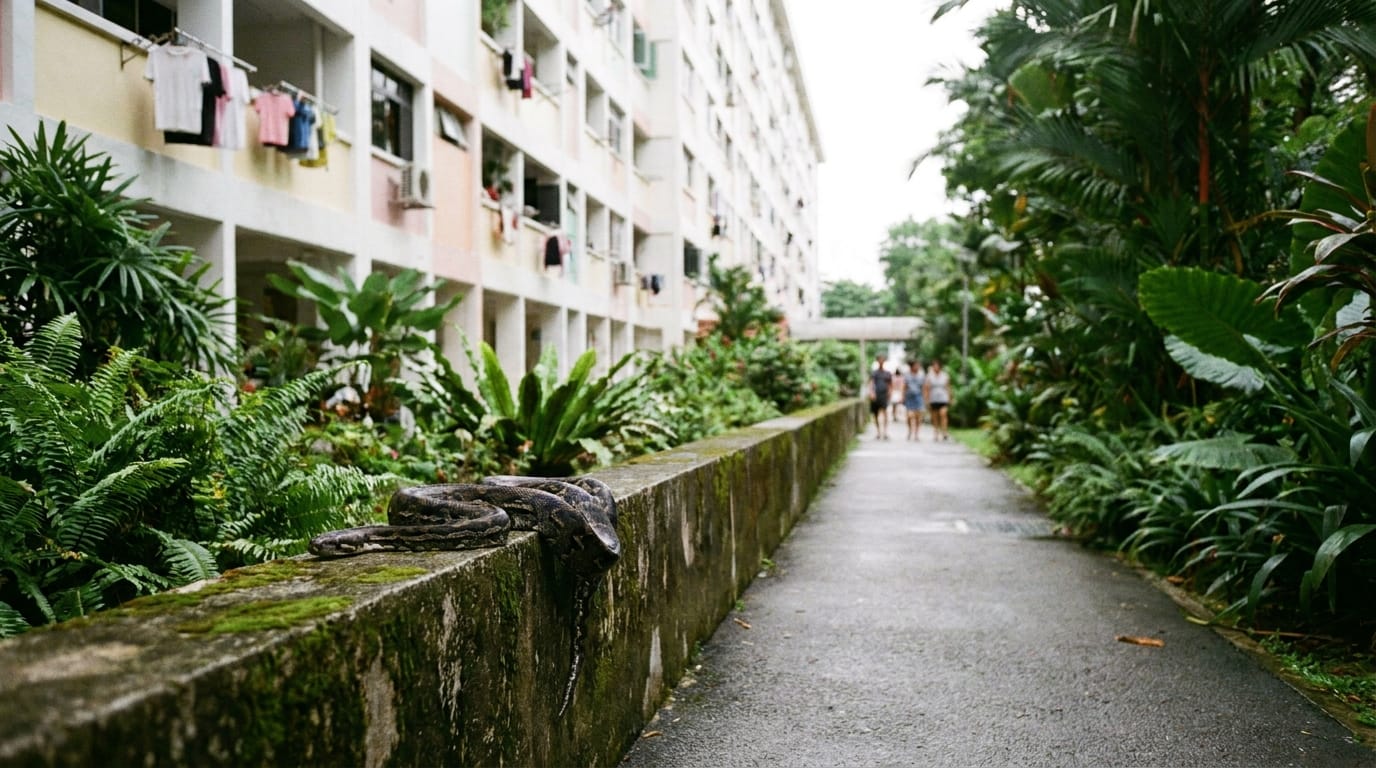
Short answer: move people and pets away, keep the snake in sight from a safe distance, and call or WhatsApp ESC on +65 9149 1408 for professional snake removal.
Singapore has more than 60 snake species, from small wolf snakes that wander into kitchens chasing geckos to reticulated pythons in drains and the occasional cobra in a garden. Snakes turn up in homes, void decks, bin centres, car parks and even bathrooms, and almost every encounter ends safely when people stay calm and give the snake space.
First: keep your distance and keep watching
Snakes in Singapore do not hunt or chase people. Most bites happen when someone tries to catch, corner or kill a snake. Knowing where the snake is, or where it went, also makes removal far faster and safer.
- Move everyone, especially children and pets, at least a few metres away.
- If the snake is indoors, leave the room, close the door and roll a towel along the gap underneath so it stays put.
- If it is outdoors with a clear way out, leave it alone and watch from a distance. A snake that can leave usually will.
- Take a photo only if you can do so from a safe distance. It helps us identify the species.
- Call or WhatsApp ESC on +65 9149 1408 and tell us where the snake is.
Snakes you might see in Singapore
Most snakes you are likely to meet here are non-venomous or only mildly venomous, but a few are dangerous, and some harmless species look like venomous ones. If you cannot tell what it is, treat it as venomous.
- Reticulated python: not venomous. Singapore's largest snake, with a net-like brown, black and gold pattern, often 2 to 4 metres long. Common in drains, canals and bin centres, where it hunts rats. A large python can give a serious bite and is a real risk to cats and small dogs.
- Oriental whip snake: mildly venomous, not considered dangerous to people. Bright green, very thin, with a long pointed snout. Easily mistaken for a vine in trees and shrubs.
- Paradise tree snake: mildly venomous, not considered dangerous to people. Black with green or yellow markings and red spots along the back. A strong climber seen on walls, trees and roofs.
- Common wolf snake (often called a house snake): not venomous. Small and brown with fine pale speckles and a pale band across the neck, and one of the snakes most often found indoors, where it hunts geckos. It bites if handled and is often mistaken for a krait.
- Equatorial spitting cobra (black spitting cobra): venomous and dangerous. Black or dark brown, it raises a hood when threatened and can spit venom towards the eyes from a couple of metres. Seen in gardens, parks, drains and around landed homes.
- King cobra: venomous and dangerous, but rarely seen. A very long olive to brown snake that mainly lives near forest.
- Wagler's pit viper: venomous. Green, or boldly banded black, yellow and green, with a broad triangular head. It sits very still in trees and shrubs, so people often walk past without noticing it.
- Banded krait and blue Malayan coral snake: both highly venomous, but shy, active mostly at night and rarely seen away from forest. The krait has bold black and yellow bands; the coral snake has a dark body with a blue side stripe and a red head and tail. Never approach either.
Snake in the toilet, drain, car or high-floor flat
Some sightings need extra care:
- In the toilet: leave the bathroom, close the door and put a towel along the gap. Do not reach over the bowl, flush, or pour chemicals or hot water in. The snake may just retreat into the pipes and come back.
- In a drain: keep people and pets away from the opening and nearby covers, and note which way it moves. Do not poke it or block the drain.
- In a car or engine bay: do not start the engine. Keep the doors and bonnet closed, move away and call. If you spot a snake while driving, pull over safely, get out and close the doors.
- On a high floor: snakes climb pipes, walls and trees beside blocks, often following geckos or rats. Close the room off and watch from outside. If it is on a ledge, air-con ledge or roof, do not lean out to reach it. Every ESC officer is trained and certified for work at height.
- In a condo common area: tell the management office or security, keep residents and pets back, and have one person watch from a safe distance. Clear play areas and pool decks until the snake has been removed.
If someone is bitten
Snake bites are uncommon in Singapore, but treat every bite as a medical emergency, even if the snake looked harmless. This is general first aid information, not medical advice. Always follow the 995 operator and medical staff.
- Call 995 for an ambulance straight away.
- Keep the person calm and as still as possible. Moving around can speed up the spread of venom.
- Keep the bitten limb still, in a splint or sling if you have one, and not above heart level.
- Remove rings, watches and tight clothing near the bite before swelling starts.
- Note the time of the bite and what the snake looked like, from a distance only. Never try to catch or kill it.
- Do not cut the wound, suck out venom, tie a tourniquet or apply ice.
- Venom in the eyes: rinse with plenty of clean water for at least 15 minutes, then get medical help.
- If a pet is bitten, take it to a vet immediately.
What never to do
A few well-meant reactions reliably make things worse:
- Do not try to catch, trap or kill the snake. It is dangerous, and harming wildlife is an offence under the Wildlife Act.
- Do not spray it, poke it with a broom or throw things at it. A stressed snake is a defensive snake.
- Do not assume a small snake is harmless. Young venomous snakes carry venom too.
- Do not corner it or block its escape route.
- Do not use mothballs, sulphur, chemicals or fire to drive it out.
What happens when you call ESC
ESC's snake removal work is led by certified wildlife specialists. When you call or WhatsApp +65 9149 1408:
- We ask where the snake is and whether anyone is at risk, and give you safety advice over the phone. A photo on WhatsApp helps us identify it.
- A trained ESC officer attends with proper snake handling equipment.
- The officer identifies the species and removes it from your premises, subject to the approvals each species requires.
- We check how it got in, such as gaps under doors, pipe openings, drains or overhanging branches.
- You get practical prevention advice, and managed properties can ask for a photo-documented report.
Preventing the next visit
Snakes follow food and shelter. Take those away and you will see far fewer of them:
- Keep rats under control. Rats are the main reason pythons and cobras come close to homes.
- Secure bins, clear food waste promptly and do not leave pet food outside.
- Seal gaps under doors and around pipes, air-con holes and cable openings.
- Keep drains and floor traps covered, and replace broken grilles.
- Trim vegetation and branches back from walls, windows and roofs.
- Clear clutter such as stacked boxes, planks and piles of leaves where snakes and rats hide.
Repeated sightings in a condo, estate or worksite
On managed properties, repeated sightings are a signal, not a coincidence. They usually point to something that keeps drawing snakes in: rats, dense ground cover, standing water or gaps around drains. A site assessment finds the cause, and the fix is often simple housekeeping or minor proofing. ESC's wildlife services are built for town councils, MCSTs and facilities managers, with clear, photo-documented recommendations your committee can act on.
The takeaway
Stay back, keep the snake in sight and call or WhatsApp ESC on +65 9149 1408. A trained ESC officer will identify the snake and remove it from your premises, subject to the approvals each species requires, then show you how to keep the next one out.
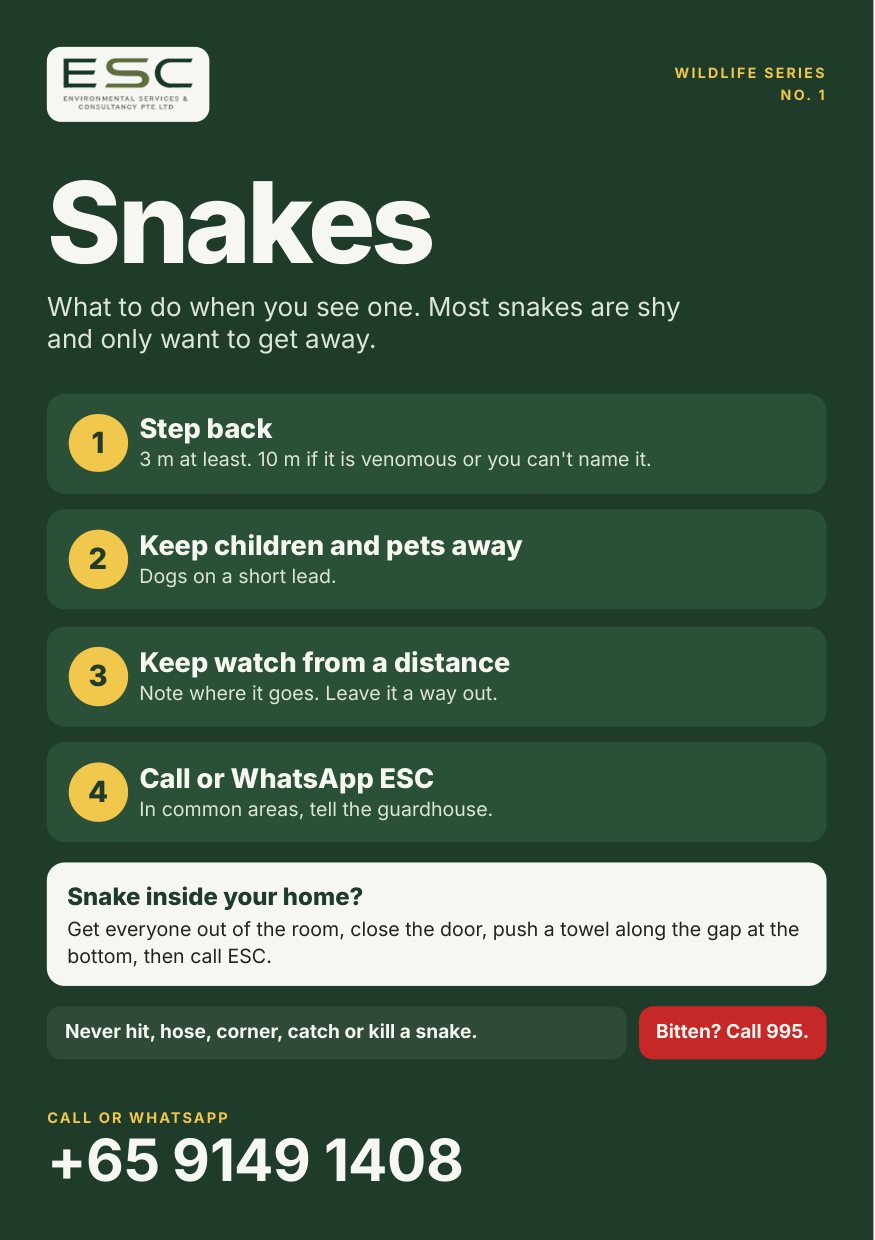
Free download · Wildlife Series No. 1
Keep the snakes booklet handy
12 A5 pages: who's who, how dangerous each one is, what to do, and first aid. Print it for your notice board or save it to your phone.
Frequently asked questions
Who should I call for a snake in my house in Singapore?
Call a professional snake removal service rather than handling it yourself. Call or WhatsApp ESC on +65 9149 1408, keep people and pets away and, if it is safe, keep the snake in sight until help arrives.
Are most snakes in Singapore venomous?
No. Most are non-venomous or only mildly venomous and not considered dangerous to people. A few, including cobras, kraits, coral snakes and pit vipers, are dangerously venomous, and some harmless snakes look similar. If you cannot tell, treat it as venomous.
Will a snake chase me?
No. A snake moving towards you is usually heading for cover that happens to be behind you. Step back slowly and give it a clear path.
There is a snake in my toilet. What do I do?
Leave the bathroom, close the door and put a towel along the gap underneath. Do not flush or try to pull the snake out. Call or WhatsApp us on +65 9149 1408 and keep everyone out until it has been removed.
How do snakes get into high-rise flats?
Usually by climbing pipes, rough walls or trees close to the block, often following geckos and rats. They also squeeze through gaps around pipes and service openings. Sealing those gaps and trimming nearby branches makes a repeat visit less likely.
Do mothballs or sulphur keep snakes away?
There is no reliable evidence that they do, and mothball fumes are harmful to people and pets. Taking away food, especially rats, and hiding places works far better.
Is it illegal to kill a snake in Singapore?
Snakes are wildlife, and killing, trapping or harming wildlife without approval is an offence under the Wildlife Act. Trying to kill a snake is also the most common way people get bitten.
Do you remove snakes from condos and estates?
Yes. We handle snakes at condominiums, HDB estates, landed homes, offices and worksites across Singapore, subject to the approvals each species requires. For managed properties we can also check the grounds for entry points and recommend practical fixes.
How much does snake removal cost?
It depends on the situation, such as where the snake is and how easy it is to reach. Call or WhatsApp +65 9149 1408 with the details, and a photo if you have one, for a quote.